
Thanks for being a subscriber to Let’s Not Be Trash. If you’re new here, we (mostly Evan J. Mastronardi , Stanley Fritz and Karina Maria), write about patriarchy, politics, race, culture, music, and ruminations. The goal is to discuss important issues in a digestible and relatable way because nobody wants to read a TED Talk.
If you’re new, please consider subscribing. If you’re already on the list and have a few coins, consider upgrading to a paid subscriber. If you have commitment issues but want to contribute, you can buy me a coffee.
If you like my substack and want to discover other great writers, check out this directory from Marc Typo, The Cook-Out.
By Guest Contributor, Director, Álvaro Franco
I wanted to like “One Battle After Another”. I really did.
My life was changed when Paul Thomas Anderson released “There Will Be Blood” and “The Master”. In fact, “The Master” was the first film that I saw in native 65mm projected on the big screen, and it was at the Ziegfeld (R.I.P). And I thought that the idea of using only deleted scenes in most of the trailers advertising the film was so novel. But if someone says One Battle After Another is in the same league as the two earlier films, I can’t take them seriously.
The first 30-40 minutes of OBAA felt like a depiction of what a millionaire thinks Antifa does—or means—filled with crass stereotypes and over-sexualized scenarios.
Overall, it resembled an attempt to modernize (or sanitize?) a film that would have been made by Robert Downey Sr. in his heyday, and making it relevant to Gen Z but with nothing profound to say about race, class, or revolution. And the screenplay definitely needed another pass, which makes me question if the movie was fast-tracked into production.
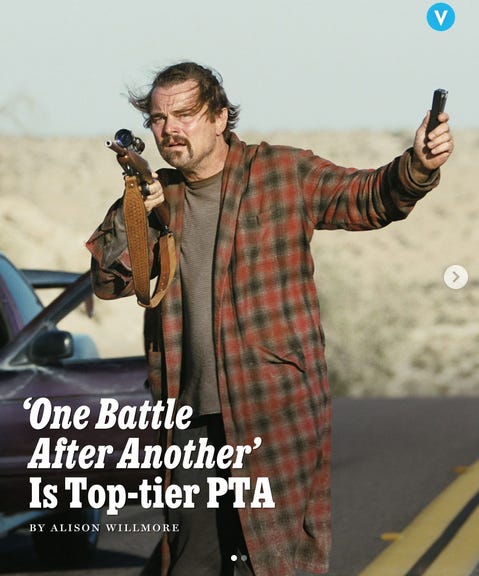
Leo’s performance as Pat/Bob seemed to consist of seeing how hard he could crash out during key dramatic moments. Pat/Bob’s daughter Willa was poorly developed (was she meant to be a cypher for the audience?), and I didn’t learn a thing about her despite her rescue being the whole point of the story. In fact, here’s a game that I would offer to people who disagree with me on that point: tell me one memorable thing about Willa or her personality (and no, martial arts doesn’t count because it’s not a character trait).
As much as I enjoyed the performances of Benicio Del Toro and Sean Penn, the ultimate tragedy is seeing PTA’s least memorable film become his biggest hit, effectively proving that he had to dilute his brand to survive in today’s film ecosystem.
In an effort to please everyone, you end up selling yourself short.
Go watch “Bulworth” instead. Or better yet, read Assata Shakur’s autobiography.
What did you think about the film? Share in the comments.
For another great piece by Substack creator Brooke Obie on this film, read:
