

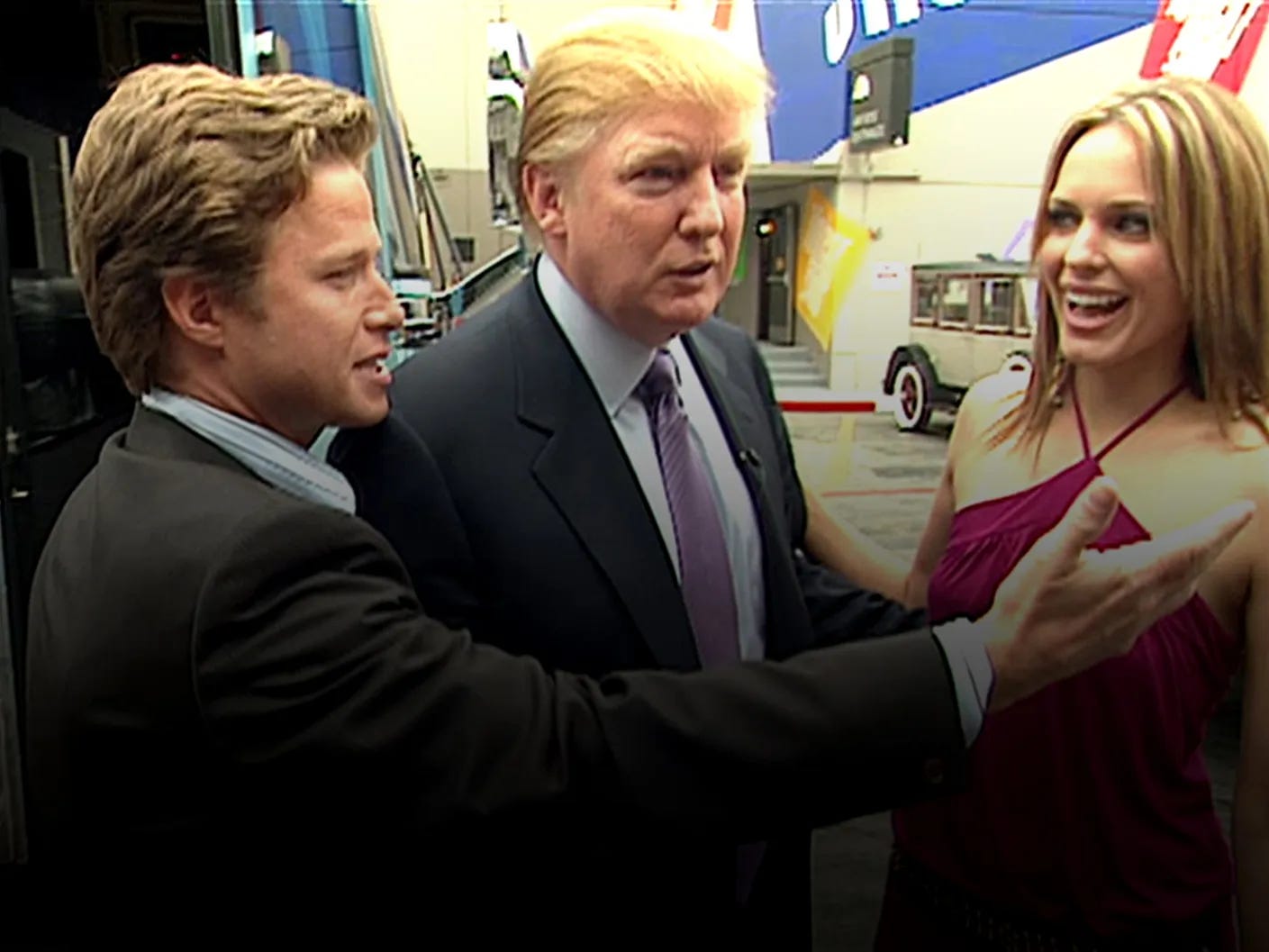
On October 7th, 2016, then-candidate Donald Trump faced the biggest challenge to his unorthadox run for President. While prepping for his debate with Hilary Clinton, his team was interrupted by breaking news related to him. The Washington Post released audio of the candidate speaking disparagingly of women while on the Access Hollywood show with host Billy Bush. In the audio, Trump bragged, saying, “ You know, I’m automatically attracted to beautiful women. I just start kissing them. It’s like a magnet. And when you’re a star, they let you do it. You can do anything. Grab em by the pussy, you can do anything.” In a world not yet used to the depths the president could go, political outcry was instant and fierce, with some Republicans even rescinding their support of Trump.
At first, I found Trump’s campaign amusing. I liked to think of him as a living humiliation ritual for the Republican Party, but after he won the nomination, the energy from his base was so strong that I began to worry he had a real chance to win. When the Access Hollywood audio dropped, I felt relieved, because surely this would be the end of his short but fiery reign. I was wrong. Despite the backlash and calls for him to drop out, Trump refused, and in the debate that followed, he brought in several women who had accused the former president of harassment and assault. This wasn’t the first time he would break norms, but it was one of the biggest at the time, and despite everything wrong with the audio, he was able to continue his candidacy as if nothing had happened.
Less than a month later, Trump defeated Hilary Clinton to become the 45th President of the United States.
Many perceived this as the moment when Trump proved impervious to any damage or consequences for his character inconsistencies. And it’s true that in the ten years since then, Trump has said and done much worse, and has rarely suffered a lasting negative impact from his base or even the broader electorate. I have spent a lot of time trying to make sense of our current reality. At face value, Trump goes against everything we say this country stands for, but somehow, he’s still here, thriving. That thought experiment has sent me into dark places, but I have been lucky enough to find the light, and in that ray of clarity, some understanding. Here is what I learned.
When people are struggling, and it feels like tough times are happening all around, it is human nature to gravitate towards those who seem strong. There is nothing wrong with strength, but our current collective understanding of what “real" strength looks like is how a Trump can exist. That understanding views strength through the prism of masculinity, a broken construct created to define manhood. Under masculinity, strength is defined by physical ability, dominance, selfishness, and consumption. And to accumulate the strength to move as you please, you must have power. That brings us to Trump. When Trump bragged about grabbing a woman “by the pussy” he wasn’t just talking flippantly; he was giving us a window into how he views power. In Trump’s mind, if you have the strength or are perceived to be powerful, you can do whatever you want, and no one can stop you.
After learning hard lessons, Trump has returned with a vengeance. The first thing he did was fill his administration with “yes men” and blind supporters. The kind of people with no actual expertise, but a deep desire to execute on whatever the president demands of them. Even if what he demands is morally repugnant or illegal. Earlier this year, the Department of Homeland Security, then led by Kristi Noem, deployed 2,000 ICE agents to the state of Minnesota to carry out an “immigration operation.” The deployment came shortly after Trump had made disparaging comments about Somali immigrants in the state, leading many to believe they were being targeted. Ice’s presence destabilized communities and caused more harm than good. Before the “operation” was completed, at least two people were killed after being shot by members of ICE, and the Trump administration refused to cooperate with local authorities.
This philosophy on power was exhibited again in Venezuela. After accusing President Maduro of trafficking drugs to the United States, the trump administration escalated even further. According to the New York Times, “U.S. military seized him and his wife in a swift and overwhelming strike on Caracas, the culmination of a campaign by President Trump and his aides to oust him from power.” This move was panned by many as illegal; despite these outcries, very little has been done to hold Trump accountable.
The interesting thing about this approach to power is that under the correct circumstances, it can seem overwhelming. For much of his second act, he has existed in such an environment. Despite some recent rumblings, the Republican Party has mostly followed him in lockstep, and his base is as ravenous in their support of him as ever. His natural opponent in the Democratic Party has rubber-stamped his appointments and spent more time going after progressives and critics of Israel’s destruction of Gaza. In the handful of moments where they have stood up, it has been through statements that do not threaten his power or attack the status quo. And with little to no opposition, he has been able to do as he pleases, while the rest of the world struggles to respond.
I know I’m not speaking for myself when I say it’s felt extremely disempowering to watch this cycle continue, and over the last few months, I have gone from actively speaking out against his administration to wondering if I should stop fighting for everyone else and get my own affairs in order. It’s a thought that scared me as soon as it formed: was I folding to his power like everyone else, or am I really this powerless?
But there is something else about this philosophy on power that is important to know. Those who believe they have carte blanche to move without repercussions are usually the least prepared when pushback occurs. And when one gets overly arrogant, it’s only a matter of time before they make a critical mistake. It seems that we are currently in that moment. After his actions in Venezuela, it seemed like Trump could do no wrong, so it was only a matter of time before he would aim for an even bigger target. We didn’t have to wait long. After what we will call some enthusiastic “encouragement” from Israel, Trump decided to take this approach to the Middle East. Ordering our military to begin bombing Iran in partnership with Israel. They believed that with a little pressure, they could force Iran to change its regime. Despite devastating destruction, Iran has continued to fight, and closed off the Strait of Hormuz, sending oil prices skyrocketing and destabalizing 20% of the world’s energy production.
Trump and co were not expecting them to do this, and it has sent them into a tailspin. Every day since the conflict began, the president has become more erratic, and our purpose for invading Iran becomes less clear. And finally, after a year and a half of getting everything he’s wanted, it looks like there is a limit to his power. But what should we take from this?
What happens next with Iran and the Middle East is unclear, and I’m not a foreign policy expert, so I won’t pontificate on it. What I do understand is power: how to build it, wield it, and use it. Trump’s views on power are tied to the idea that certain people have the right to do and take what they want, and they should. People who think this way usually target those they believe are weaker than themselves.
\They do this because they aren’t actually as powerful as they project to be. And if more people had stood up when these type of people first started their reign of terror, the damage they caused could have been significantly reduced. Staying silent and choosing not to fight is a losing game. Because every time a Trump-like figure dominates a more vulnerable opponent, that facade slowly fades away until it is a fully realized entity with overwhelming strength, and when that moment comes, staying quiet, choosing to only care about ourselves, attempting to negotiate, pontificate, and appease will mean nothing, because we will be faced with our failures.
Congratulations, you made it to the end. What did you think of this post? Here are some helpful prompts to get you started:
Do you agree with how I define Trump’s view of Power and Strength?
Do you think our current views of Power/Strength are healthy?
Is there such a thing as healthy Power?
What do we need to do in order to find healthier versions of strength and leadership?
History teaches us that the most so-called powerful men are brought down by heart attacks, which can be a violent way to go. Here are some examples from good ol Claude: Julius Caesar — Assassinated, stabbed 23 times by Roman senators (44 BC)
Genghis Khan — Likely died from injuries after falling from a horse, possibly combined with illness (1227)
Ivan the Terrible — Died of a stroke while playing chess (1584)
Joseph Stalin — Died of a stroke, possibly helped along by subordinates who delayed calling doctors (1953)
Mao Zedong — Died of motor neurone disease and heart attacks (1976)
Pol Pot — Died of heart failure while under house arrest (1998)
Francisco Franco — Died of organ failure after prolonged illness, age 82 (1975)
“The truth is, that all men having power ought to be distrusted.” – James Madison