

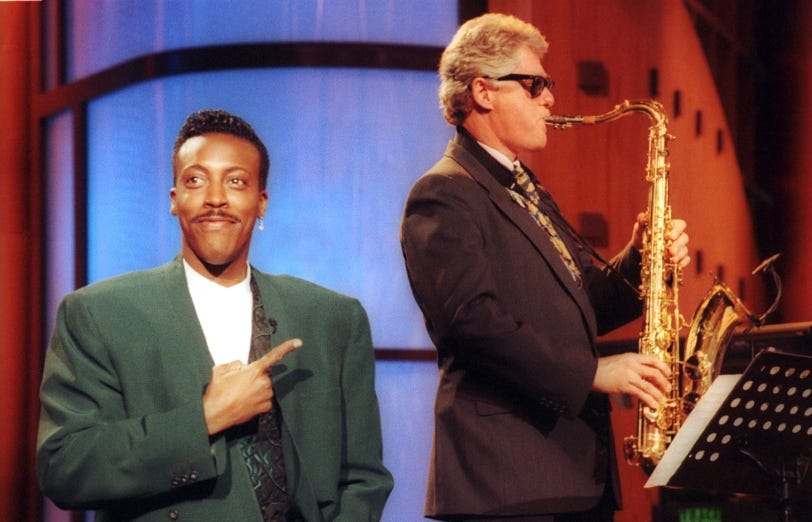
There was a time, surely before some of the people reading this may remember, where the joke among some communities was that Bill Clinton was America’s first Black President. To be fair, it was more of a tongue in cheek comment, than something people actually believed. But for a period, the former president held a stellar relationship with Black voters.
And with good reason, as president, he appointed multiple Black cabinet secretaries, and while some elected officials were trying to backtrack on affirmative action, Clinton pushed to strengthen and improve it, declaring in 1995 that it was “Good for America”. But the moment that shines brightest is the famous image of Clinton playing the saxophone on the Arsenio hall show.
That moment, as well as his ease with and around Black people, more than anything he did before becoming president, endeared him to Black people everywhere. That relationship grew stronger when he became president and presided over a strong economy that saw wages and home ownership opportunities for many Americans increase.
By most metrics, Clinton had a successful tenure as president, and because of that, the lesson’s Democrats took from him wasn’t just how to win an election, but how to govern. Under Clinton’s governing philosophy, you campaigned in prose, but in governance, you needed to be willing to shift right in order to keep the white more moderate voters happy. Even President Obama’s time in office was influenced by this philosophy. Through this approach, both men were able to accomplish amazing things as Commander in Chief. But for as much success Clinton had with his approach, everything wasn’t perfect. In fact, there were dire consequences for some communities.
After spending the first part of his administration fighting with congress, President Clinton worked with republicans to pass a “welfare reform” bill that gave states the power to dictate how poor people would receive benefits, making it hard or even impossible for some people to qualify. And then before the ink was dry, he worked with republicans to pass a crime bill that accelerated incarceration rates across the country. In both policy choices, the constituency that suffered the most were Clinton’s favorite base, Black people.
Clinton and Obama’s success seemed to have lulled the Democratic party into a simple idea; if they focus on charismatic leaders who could build a broad coalition, led by Black voters, while running on a platform that is high on hope, and charisma, but flexible on policy, they hold power.
That approach was successful with Clinton and even Obama, but the results have been inconsistent in every other lever of power they have fought to control. For one, very few people hold the star power of the former presidents. Secondly, while they both wowed voters with their charm, and oratory skills, they also ran on policy. Both pushed for fundamentally changing the country’s healthcare system, Clinton fell short, and Obama succeeded. But both were clear about a need for this shift. We can argue over whether this was the issue that needed the most attention, but it is clear where they stood.
Since then, the only thing Democrats have been able to offer is that they are “not Donald Trump” and when given a chance to vote on significant policy that would positively impact Americans. They have been sabotaged by their own party members, or stifled by unelected actors. When voters on the left, or really anyone, has pushed back on the Democrats inability to deliver for working people, they have always stressed the necessity of reaching across the aisle, similar to the ways Clinton did.
This strategy served Democrats for a long time, but Clinton is no longer president, and while Democrats still have a strong hold on the Black vote, it is weakening, and as a result, so has their ability to win races at the State, local, and federal level. Today, more than any other time, Black voters are wondering out-loud, what benefit exists with voting Blue. This sense of questioning has created an opening to win the support of Black voters, and as this conversation gets louder, a new player, the Democratic Socialist of America (DSA) has entered the field. The group has been slowly building power all over the country, but nowhere is their influence felt more than in New York City.
In fact, by the time you read this, New York City will be in the final hours of some of the most interesting primary elections in recent years. After surprising the establishment with his historic run for Mayor, Democratic Socialist, Zohran Mandani is putting his political power to work, endorsing a slate of candidates to replace long standing establishment Democrats And while many people are excited for the slate, there is real tension between Zohran, DSA and the Democratic establishment, who are not thrilled with attempts by the organization’s attempts to expand it’s electoral base. This tension has boiled over on social media, where criticism of DSA has reached new heights. In the 10-years since DSA has risen to power and notoriety in this city, they have consistently faced a handful of the same criticisms. Below are just a few.
DSA doesn’t care about governance, they just want seats.
DSA members are transplants who just moved to New York, and have no respect for the people who have done the work.
DSA’s policies are too radical and don’t reflect the electorate.
But the loudest, and most consistent critique of DSA is that the organization is majority white, and does not care about Black/Brown people. In fact, some have argued that the organization lacks an understanding of Black people, and does not have a “Black Agenda” These arguments have begun to spill off of the mean streets of twitter and into real life, so it’s important to investigate the critique.
In a way it’s true. DSA is majority white, most of its top leaders are white, most of its rank and file members are white. And at least in New York, their biggest victories have come from securing support from non black voters at a high enough clip to make up for their usually middling Black support. The best example of this is Zohran Mandani’s victory over Andrew Cuomo for Mayor.
As someone who was born, raised and lived in NYC for my entire life, I can tell you that there were major obstacles in the way of Zohran building in-roads with Black voters. And some of those obstacles came from the Black Political Establishment, who were deeply entrenched with the Democratic party, and supported Andrew Cuomo for Mayor. But still, Democrats do not have a monopoly on all Black people or voters. And if DSA is truly interested in a multi-racial movement, they will need to work harder to recruit more Black people so that their base is reflective of values they stand for.
So yes, DSA has work to do, but to criticize them for “not having enough Black people,” or not having a “Black Platform,” when the Democratic Party nationally, and locally is absent of a platform for Black people, and can also have little to no Black people in their leadership spaces is the pot calling the kettle black. At this current moment, what makes the Democratic party a better option for Black Voters?
Black voters have consistently voted Democrat, and for far too many years, they have been rewarded with excuses, when promises were broken, or lectures in response to reasonable demands. The truth is, no one has delivered for Black voters, not in a substantial way. I would argue that outside of criminal justice, most of the political establishment has no idea what black communities/voters actually want/need.
And even if they did, Black people would not be centered in the demand for it, because most people in power are afraid that by loudly advocating for policies that center Black people, they will lose support from white working class voters. They’re not wrong, a recent study showed that white opposition to some welfare programs increased because of “racial resentment”. White supremacy isn’t something that can be addressed in one election cycle, so for many in the establishment, it has been easier to avoid issues that may rile up their white voters.
The ugly truth is, issues centered on Black people are usually dismissed as “Radical” or “divisive” and until we as a country deal with the plague that is white supremacy and Racial capitalism, this will continue to happen.
But here is where I give DSA more of a pass than I do the Democratic Party. DSA has consistently supported Universal healthcare and childcare, supportive housing, worker protections, and robust consumer protections that help regular people. While some Democrats have also supported these policies, the establishment has been slow to tag along, or in some cases out-right hostile to these policies. The work that Zohran Mandani is doing on deed theft will help Black home owners.
The efforts to shift the NYC property tax code, if done right, can help Black homeowners. Climate policies that shift to sustainable resources and attempt to undo some of the damage we have done to this earth, help Black people. DSA may not have a Black agenda, but the policies they fight for would have a significant net positive impact on Black people and communities.
And while Republicans are always the first to push-back against the type of policies listed above. Many in the Democratic party have been just as vocal, and enthusiastic in their efforts to undermine these policies. The same members of the establishment who accused DSA of not doing anything for Black people.
I am not trying to argue that every Democrat is useless, or in active opposition to impactful reforms. In New York, none of the progress that has been made over the last ten years would be possible without strong leadership in the State Legislature. Assembly Speaker, Carl Heastie, and Majority Leader, Andrea Stewart Cousins have worked with progressive groups to pass a laundry list of important reforms, including; bail reform, closing the LLC loop hole, the Climate Community Protection act, The Dream Act, Marijuana legalization, and the suite of housing bills that eventually passed in 2019.
But many of these reforms happened against the wishes of the most powerful democrats in the state. From their point of view, these policies broke away from the tried and true program of charisma, and concessions. The approach that won Bill Clinton so much success. By abandoning the Clinton way and voting for the bills listed above, many in the New York State legislature risked their reputation, and careers. What part of that serves the Black community?
So yes, the DSA has a lot of work to do, and I hope they put real time and energy into engaging with Black and Brown people in Black and Brown communities. I hope they do this in a way that is authentic, and creates a structure of shared power. But while they figure things out, Democrats do not have a stable foot to stand on. Instead of attacking DSA, and progressive groups, they need to ask themselves, “What do we stand for” and “What can we actually deliver for our supporters.” Until they answer these questions in a real way, they will continue to lean on the outdated politics of Clinton, until there’s no one left.
This is such an important piece. Democrats have gotten away with murder, and with respect to concessions or actively complicity in crime policy and national security, that is the literal truth. It's telling that they continue to NOT answer the question of what they stand for, because the real answer is they stand for personal gain, and that's not something they can admit to voters. I think the DSA issue hits on something the advocacy community writ large struggles with. Our coalitions implode with clockwork regularity because we're not really in relationship with one another, beyond professional settings. Even the most well meaning white person lives and operates in a completely different world than the Black community, and same goes for other racial/ethnic communities. DSA has work to do, as do we all frankly (and I would challenge it's critics to start with themselves!), but I get why they started building where they had a base.
Great piece, Stanley. The DSA has a lot of work to do, but at least they are out there doing work, right? At least they have a platform, any platform, for progressive economic change, while the institutional NYS Democratic Party just lives on the defensive: (a) try to defend programs enacted decades ago from getting cut by DC Republicans, (b) try to protect rights granted by past, liberal SCOTUSes from today's conservative SCOTUS, and, well, that's it, right? There's no (c), is there?